

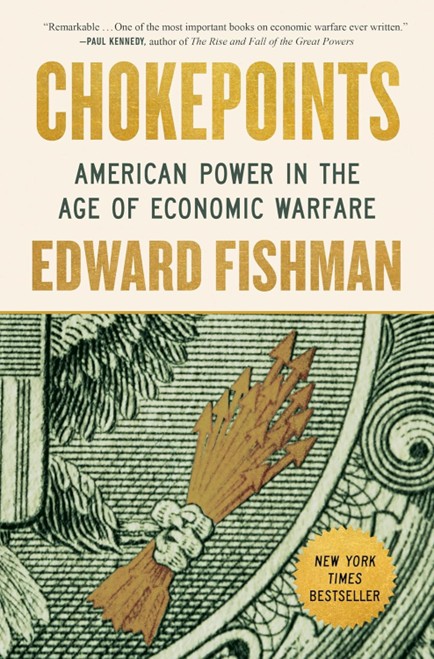
How America Weaponized the Global Economy: Inside Chokepoints
By Edward Fishman
AN INSTANT NEW YORK TIMES BESTSELLER
“Deftly written, Chokepoints is a compelling and dramatic narrative about the new shape of geopolitics.”
— Daniel Yergin, The Wall Street Journal
“A timely, riveting world tour… an absorbing book.”
— The Economist
“Remarkable… One of the most important books on economic warfare ever written.”
— Paul Kennedy, author of The Rise and Fall of the Great Powers
For centuries, crippling a rival nation meant blockading its ports, invading its territory,
or laying siege to its cities. Today, the battlefield looks very different. A single statement
posted online by the U.S. government can send shockwaves through global markets, collapse
currencies, and bring entire industries to a halt.
In Chokepoints, Edward Fishman—a former senior U.S. State Department sanctions official—
pulls back the curtain on one of the most consequential shifts in global power over the last
two decades: the transformation of the world economy into a weapon of war.
The Rise of Economic Warfare
As globalization accelerated in the late 20th century, many believed economic integration
would reduce conflict. Instead, the opposite happened. Facing the growing assertiveness of
Russia, China, and Iran, the United States began to abandon the old gospel of free-flowing
globalization and embrace a new strategy—economic warfare.
Rather than relying on military force, U.S. policymakers exploited America’s dominance over:
- Global finance (Wall Street)
- Advanced technology (Silicon Valley)
- Energy markets (Big Oil)
Sanctions, export controls, financial blacklists, and technology bans became the primary tools
of confrontation. Presidents from both political parties increasingly turned to these measures
to respond to international crises—sometimes with stunning success, and sometimes with
devastating unintended consequences.
Inside the Back Rooms of Power
One of the book’s greatest strengths is its insider perspective. Fishman takes readers deep
into the back rooms of Washington, revealing how a small and eclectic group of diplomats,
lawyers, economists, and financial experts designed and executed America’s new economic arsenal.
These policy innovators reshaped U.S. foreign policy by identifying critical
chokepoints
in the global economy—places where American influence was so strong that
cutting access could cripple adversaries without firing a single shot.
A Fractured Global Economy
While economic warfare has become the United States’ primary response to global threats,
its long-term consequences are profound. Chokepoints shows how these strategies have fueled:
- A global economic arms race
- The fragmentation of supply chains
- A growing divide between competing economic blocs
The world we live in today is one where great powers are no longer just trading partners—but
economic rivals prepared to weaponize interdependence itself.
Why Chokepoints Matters
Chokepoints is more than a history of sanctions and policy decisions. It is a definitive
account of how America pioneered a new, hard-hitting style of economic warfare—and how that
strategy is reshaping geopolitics, global trade, and the future of international cooperation.
For anyone seeking to understand today’s fractured world order, this book is essential reading.